
Articles
Why Verification Changes the Economics of International Recruitment

The hidden economics of partner selection
International recruitment is often evaluated through visible variables: recruitment fees, timelines, candidate availability, and deployment costs.
But some of the most consequential costs appear elsewhere.
A partner that looks competitive commercially may create additional coordination, replacement, delay, compliance, or execution costs later in the process.
This means the economics of international recruitment begin with partner selection, not candidate sourcing.
Access is not the same as capability
The existence of a recruitment company in a source market does not necessarily mean that the company is suitable for a specific workforce requirement.
A partner may be legally established while still lacking:
- sufficient sourcing capacity
- experience in the required occupations
- appropriate screening processes
- operational discipline
- documentation capability
- reliable communication
- experience with Saudi-market requirements
Verification therefore needs to answer a more useful question than:
Does this company exist?
It needs to answer:
Can this company reliably execute this requirement?
The cost of discovering problems too late
Weak partner selection frequently transfers risk downstream.
Problems that could have been identified before engagement may instead emerge during sourcing, documentation, mobilization, or deployment.
The resulting cost is not limited to money.
It can include:
- Time: delays caused by insufficient sourcing capacity or weak coordination.
- Management attention: repeated follow-up, escalation, and corrective intervention.
- Candidate quality: inconsistent screening or misunderstanding of requirements.
- Operational predictability: uncertainty around documentation, interviews, approvals, and deployment.
- Commercial relationships: missed commitments can affect trust between employers, Saudi recruitment companies, and international partners.
The later a structural problem is discovered, the more expensive it usually becomes to correct.
Verification should evaluate capability, not paperwork alone
Document verification is necessary, but it is only one layer of due diligence.
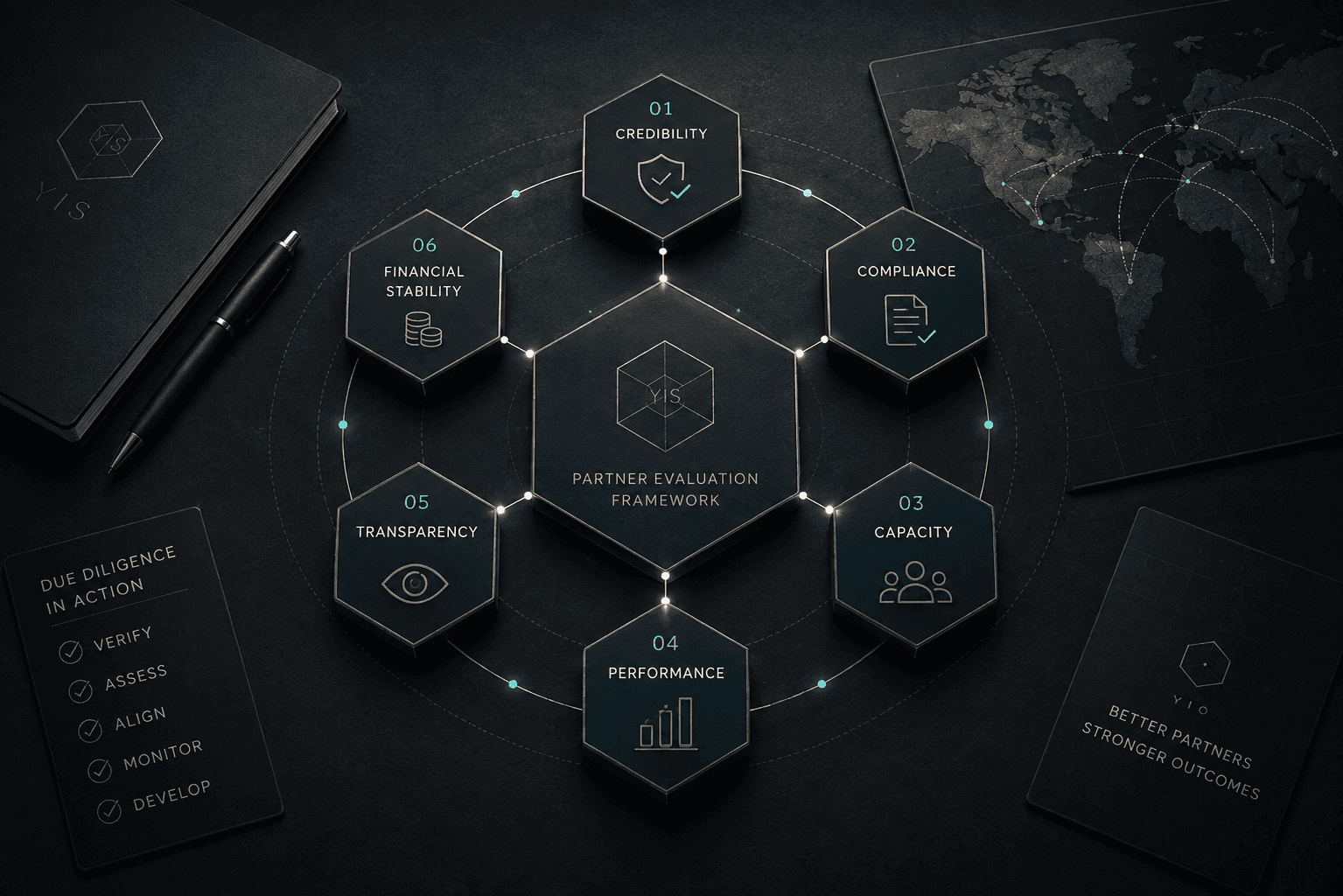
A stronger evaluation framework examines several dimensions:
- LegitimacyLicensing, legal status, operating history, ownership, and relevant authorizations.
- Recruitment capabilityCountries, sectors, occupations, sourcing channels, candidate pools, and realistic deployment capacity.
- Operational maturityScreening processes, documentation workflows, communication standards, escalation procedures, and internal accountability.
- Track recordPrevious recruitment programs, client experience, deployment history, and evidence of execution.
- Market readinessUnderstanding of Saudi requirements, expectations, timelines, and operating environment.
- Strategic fitWhether the partner's actual capabilities align with the specific workforce requirement.
The goal is not a universally "good" agency, but the partner suited to the specific requirement at hand.
Verification improves more than risk management
Verification is often treated as a defensive measure, a way to avoid bad partners, but that view is incomplete.
Good verification also improves decision quality.
When organizations understand the real capabilities of potential partners, they can make better decisions about:
- where to source
- which partner should handle each requirement
- realistic deployment volumes
- expected timelines
- contingency options
- how responsibilities should be structured
Verification becomes an information advantage.
Better information changes the economics of recruitment, because fewer decisions are made under uncertainty.
From supplier lists to partner intelligence
Many organizations accumulate large networks of recruitment agencies.
A large network can look impressive, but size alone has limited strategic value.
What matters is how much is actually known about each partner:
- Where can they recruit?
- What can they recruit?
- At what scale?
- Under what conditions?
- How consistently have they delivered?
- Where are their operational limitations?
A smaller network with structured intelligence can be worth more than a large directory of unverified contacts.
The real advantage is not access to partners. It is structured knowledge about them.
YIS Perspective
At YIS, we view verification as the first layer of partnership architecture.
Our approach is based on a simple principle:
Do not begin with the introduction. Begin with understanding capability.
Verification, evaluation, alignment, coordination, and follow-up should operate as connected stages rather than isolated activities.
Successful international recruitment partnerships are rarely built on access alone. They depend on aligning capability with requirement.
Key Takeaway
The cheapest recruitment option is not necessarily the option with the lowest quoted cost.
A more useful calculation considers the cost of uncertainty, delays, management intervention, poor alignment, and execution failure.
Verification reduces that uncertainty before it becomes operational cost.


Building an international recruitment partnership?
Start with a clearer understanding of partner capability before making the connection.
Start a conversation