
Articles
The Difference Between a Recruitment Agency and a Structural Partner
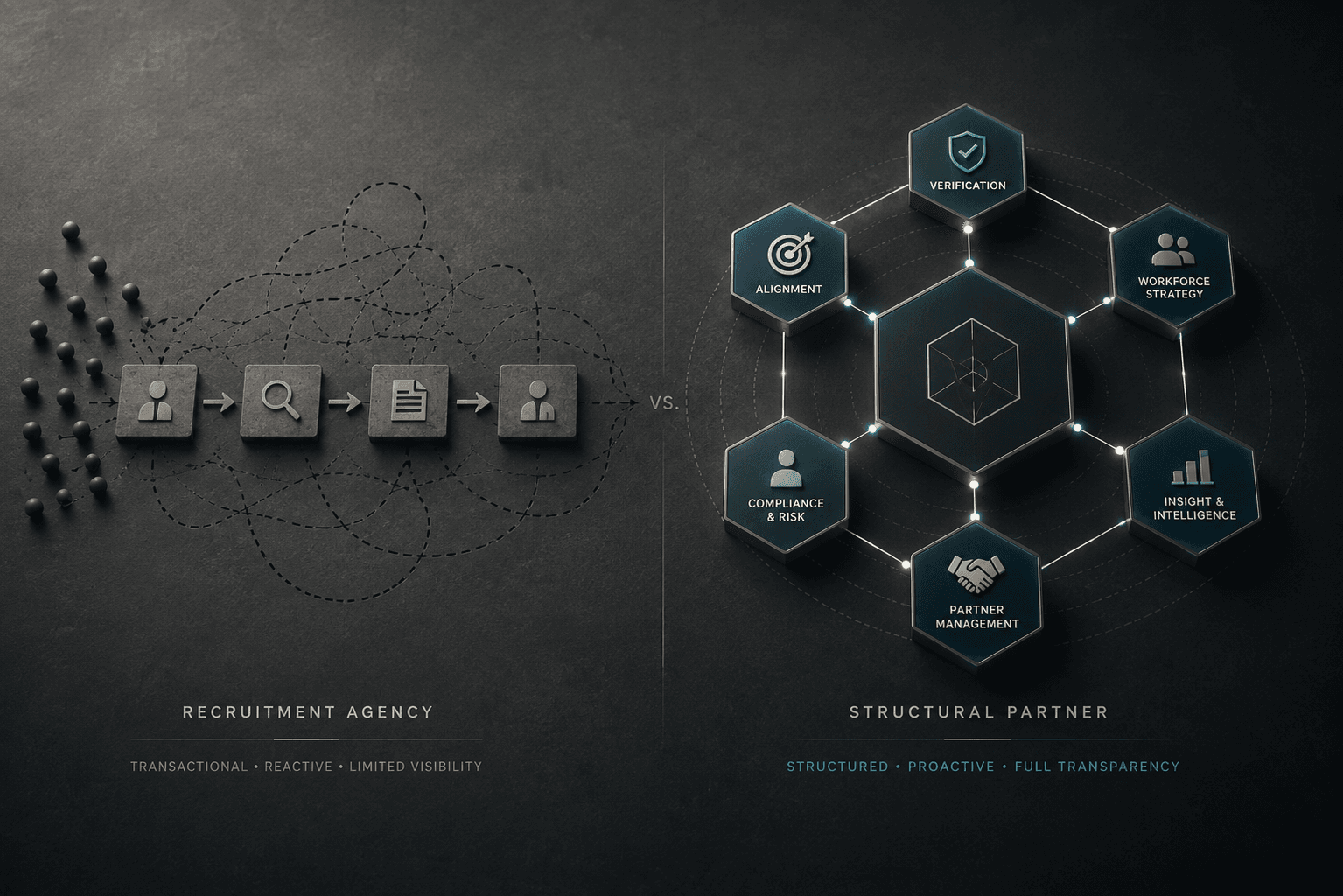
Where the distinction begins
Recruitment agency and structural partner are sometimes treated as interchangeable labels: different branding for a similar service.
The more useful distinction is about scope. A recruitment agency operates primarily inside a transaction: a specific workforce requirement, sourced, screened, and filled. A structural partner operates around a relationship: the ongoing set of requirements, partners, and outcomes that any single transaction is only one part of.
Neither role is inherently more capable than the other. They serve different functions within the same workforce ecosystem.
What a recruitment agency contributes
A recruitment agency's core function is executing the transaction itself.
That function typically includes:
- sourcing candidates against a stated requirement
- screening and shortlisting
- documentation and processing
- mobilization
- deployment
This work is specialized, operationally demanding, and essential. Nothing in a structural partnership replaces it.
The environment around the transaction
A single recruitment transaction rarely happens in isolation.
Around it sit a number of other considerations:
- multiple stakeholders across the employer, the Saudi recruitment company, and the international partner
- the accuracy of the original requirement
- documentation and regulatory conditions
- communication standards between parties
- risk introduced by any one party's capability gaps
- visibility into how past placements actually performed
- continuity once the immediate requirement is filled
Most of this environment falls outside what a single transaction is designed to manage.
Defining the structural partner
A structural partner does not execute recruitment in place of the organizations already doing that work.
It builds and maintains structure across the relationships and processes connecting them: the verification behind partner selection, the alignment behind a stated requirement, the coordination between parties, and the follow-up that confirms outcomes actually held.
The transaction still happens. What changes is what surrounds it.
Comparing the two operating models
The difference becomes clearer across a few concrete dimensions:
- Primary focusA recruitment transaction is measured by whether a placement is completed. A structural partnership is measured by whether the requirement, the partner, and the outcome stay aligned over time.
- Time horizonA transaction is scoped to a single requirement. A structural partnership extends across multiple requirements and recruitment cycles.
- Partner selectionIn a transaction, a partner is engaged for a specific need. In a structural partnership, partner capability is verified and tracked independently of any single requirement.
- Requirement alignmentA transaction begins once a requirement is stated. A structural partnership tests whether the requirement is understood correctly before sourcing begins.
- CoordinationA transaction coordinates the parties needed to complete one placement. A structural partnership coordinates across multiple parties, requirements, and timelines at once.
- Performance visibilityIn a transaction, performance is visible mainly through that placement's own outcome. A structural partnership tracks performance across placements, so patterns are visible before they become problems.
- Relationship continuityA transaction can conclude when the placement is made. A structural partnership is maintained between requirements, not restarted for each one.
- Institutional knowledgeIn a transaction, what is learned about a partner or a requirement often stays with the individuals involved. A structural partnership retains that knowledge as part of the operating structure itself.
None of these dimensions makes the transactional relationship wrong for its purpose. They describe what a structural partnership adds on top of it.
Why complexity raises the value of structure
The case for structure strengthens as complexity increases: multi-country sourcing, multiple suppliers, larger workforce requirements, and operating conditions that shift over time.
Growth in recruitment volume does not only add transactions. It adds relationships, dependencies, handoffs, and points where a requirement can be misunderstood or a commitment missed.
Each additional party and each additional requirement increases the number of places where structure, or its absence, becomes visible.
YIS Perspective
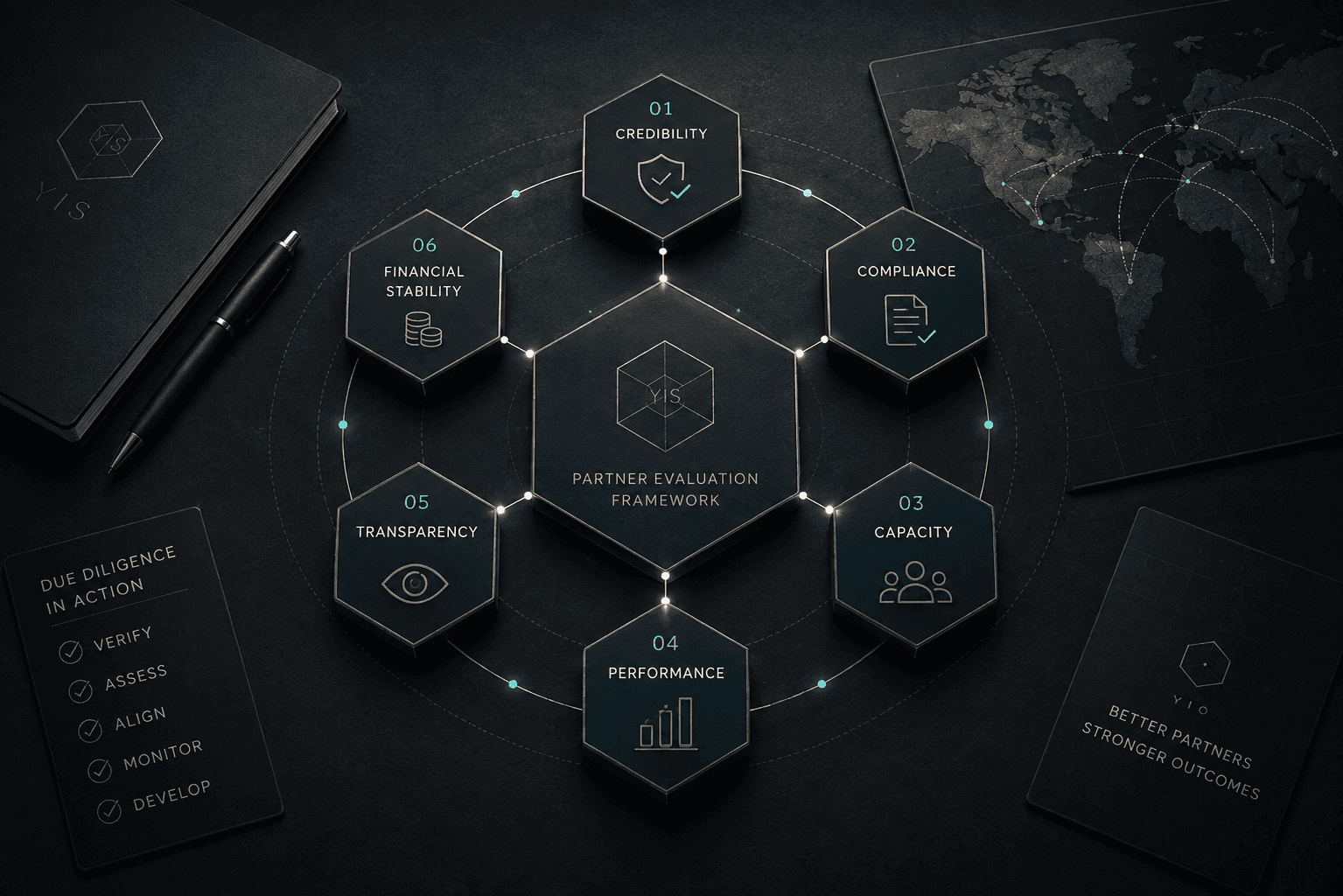
YIS operates around the recruitment transaction: building the verification, evaluation, alignment, coordination, and follow-up that connect the organizations already executing it.
That role also includes the ongoing development of international partnerships, so the same structure carries from one requirement to the next.
A partnership is proven in the time between transactions.
Key Takeaway
Recruitment delivers the transaction. Structure preserves the relationship across transactions.
A single successful placement says little about whether the underlying relationship can be repeated at scale, across multiple requirements, partners, and markets.
Structural partnership is what allows an organization to answer that question with evidence rather than assumption.


Structuring international workforce relationships at scale?
Start with a clear view of where transactional execution ends and structural partnership begins.
Start a conversation